Manta Rays: A Complete Guide to the Ocean's Gentle Giants
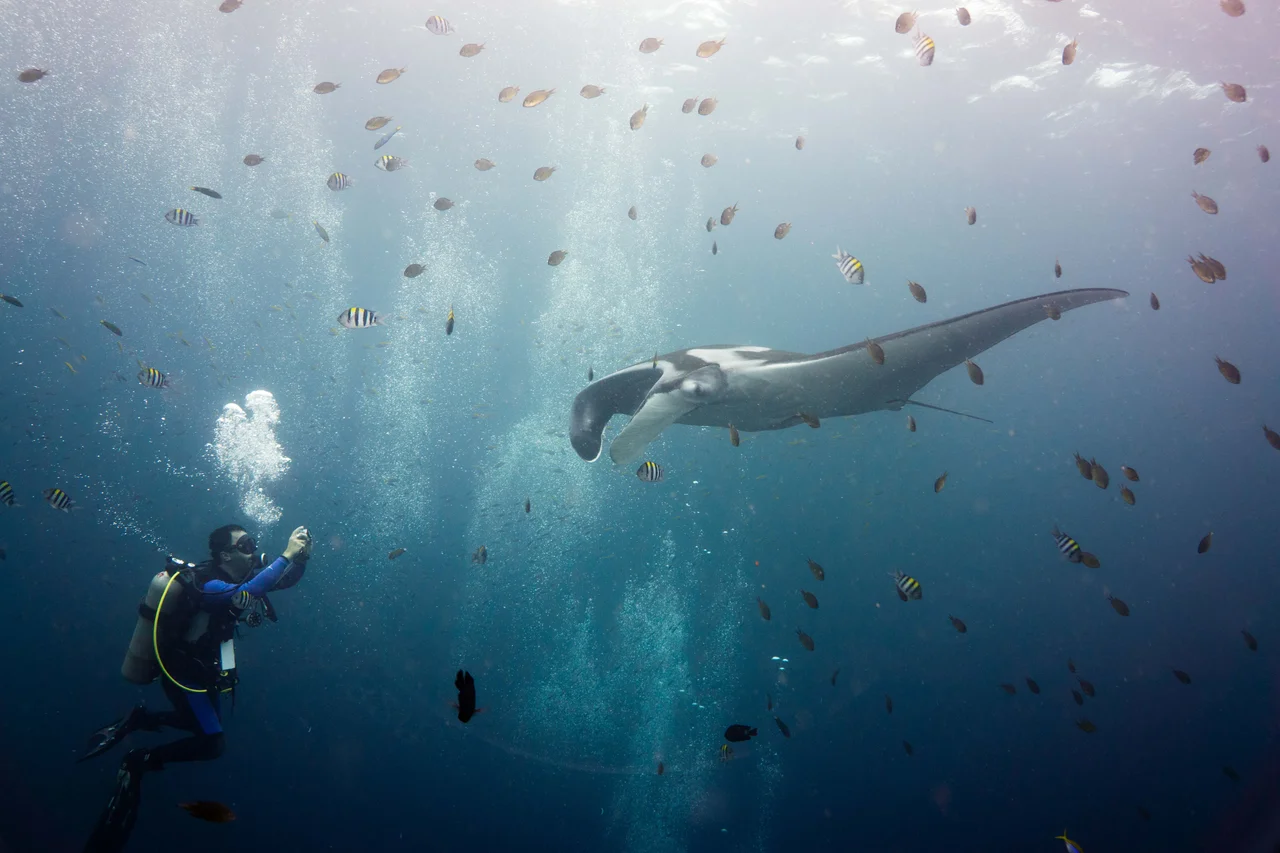
Manta rays: a complete guide to the ocean's gentle giants — biology, best dive sites, and tips
Discover everything about manta rays — their biology, behavior, two species, best dive sites worldwide, conservation status, and photography tips.
Introduction
There is no underwater experience quite like a manta ray encounter. As a manta glides overhead — wingtip to wingtip perhaps three, four, five meters wide — the sheer scale of the animal registers in your chest before it registers in your mind. They move with impossible elegance, banking and spiraling through the water column with the casual authority of something that has been perfecting its design for millions of years.
Biology and Anatomy
Manta rays belong to the family Mobulidae. Despite their size, they are entirely filter feeders, consuming vast quantities of zooplankton and small fish larvae.
Cephalic fins — Flat, horn-like extensions that funnel water into the mouth during feeding.
No tail spine — Unlike stingrays, manta rays have no venom spine. They are completely harmless to divers.
Size — Reef mantas reach wingspans of 3-4 meters. Oceanic mantas can exceed 7 meters.
Two Species
Reef Manta (Mobula alfredi)
The more commonly encountered, with a smaller home range associated with coastal reefs. Typically 3-4 meter wingspan. The Maldives, Raja Ampat, and the Great Barrier Reef host the world's most studied populations.
Oceanic Manta (Mobula birostris)
The world's largest ray, crossing entire ocean basins following oceanographic features. Classified as Endangered on the IUCN Red List.
Behavior and Intelligence
Manta rays display behavioral complexity strongly suggestive of high-order cognition. Their brains are proportionally the largest of any fish species. They have demonstrated curiosity toward divers, play-like surface behavior, and responses in mirror tests that researchers interpret as possible self-awareness.
Best Places to Dive with Manta Rays
Raja Ampat, Indonesia
Widely considered the world's largest aggregations of reef mantas. Manta Sandy and Manta Ridge near Arborek village offer spectacular encounters.
The Maldives
Year-round manta encounters with both reef and oceanic mantas. South Ari Atoll's resident population and North Male's seasonal aggregations.
Komodo National Park, Indonesia
Nutrient-rich upwellings make this one of the richest marine ecosystems. Cleaning stations at Makassar Reef offer year-round encounters.
Socorro Islands, Mexico
Giant oceanic mantas famous for extraordinary curiosity — they actively approach divers. Liveaboard-only diving.
Kona, Hawaii
The night manta dives are among the most famous in the world. Underwater lights attract plankton; mantas arrive to feed, performing barrel rolls directly over kneeling divers.
Conservation Status
Both species listed as Vulnerable (oceanic mantas Endangered). Primary threats: targeted fishing for gill plates, bycatch, vessel strikes, and climate change. Positive developments include manta sanctuaries in Maldives, Raja Ampat, Fiji, Palau, and Hawaii.
Photography Tips
Use wide-angle lenses (14-24mm). Approach from below. Never block the manta's path. Use natural light at cleaning stations. Shoot in burst mode. Include environmental context.
Conclusion
Manta rays inspire awe in a way that few marine animals can match. When a manta circles you and lingers — it feels less like an encounter with wildlife and more like a conversation across species.
Written by GeckoDive Team
The official GeckoDive team sharing diving knowledge, gear reviews, and destination guides.