Derawan Islands Diving Guide: Turtles, Mantas, and a Magical Jellyfish Lake
Derawan Islands are home to the famous Kakaban jellyfish lake and abundant sea turtles
The Derawan Islands in East Kalimantan offer green turtles, manta rays, pristine atolls, and the world-famous Kakaban Jellyfish Lake—a bucket-list diving destination.
Overview: Borneo's Underwater Jewels
Off the northeast coast of Borneo, in the warm waters of the Celebes Sea, the Derawan Islands Archipelago forms one of Indonesia's most biologically diverse and visually arresting marine environments. Four main islands—Derawan, Kakaban, Maratua, and Sangalaki—anchor a network of reefs, atolls, and open-water passages that support an extraordinary cast of marine life. Green sea turtles nest on the beaches in numbers that will stop you in your tracks. Manta rays glide through cleaning stations with balletic grace. And on Kakaban Island, a landlocked lake holds a population of stingless jellyfish so vast and so surreal that snorkelling or diving among them ranks as one of the most otherworldly experiences available to any ocean explorer.
The Derawan Islands are not Bali. Getting here takes effort, and the infrastructure is simple. But for divers who measure a destination by the quality of its encounters rather than the comfort of its sun loungers, Derawan delivers something that heavily trafficked dive resorts simply cannot: genuine wildness, in a setting of rare natural beauty.
Getting to the Derawan Islands
The gateway to Derawan is Berau, a city in East Kalimantan accessible by direct flights from Balikpapan and Jakarta. From Berau, travellers transfer to the coastal town of Tanjung Batu, where speedboats make the roughly 90-minute crossing to Derawan Island. The journey involves coordination—flights, ground transfers, and boat timings rarely align perfectly—so building buffer time into your schedule is wise.
Alternatively, several live-aboard operators run dedicated Derawan itineraries, departing from Balikpapan or Tarakan. A live-aboard is arguably the ideal way to experience the archipelago: it eliminates the daily transfers between islands and gives you access to the outer atolls at first light, when conditions are best.
Best Time to Visit
The Derawan Islands are diveable year-round, but March through November offers the most stable conditions. April and May are particularly celebrated: seas are calm, visibility is at its clearest (often 20–30 metres), and manta ray activity at Sangalaki peaks. Turtle nesting activity is also highest between May and August.
The wet season from December through February brings increased rainfall and occasionally rougher surface conditions, but diving remains possible and the crowds—never large to begin with—thin further. Water temperatures are consistently warm at 27°C to 30°C, making a 3mm wetsuit or even a rashguard sufficient for most divers.
The Four Islands and Their Highlights
Derawan Island — Turtles at Every Turn
Derawan Island is the archipelago's hub, home to most of the accommodation and the majority of visiting divers. The reef surrounding the island is a green turtle superhighway. These ancient reptiles are so abundant and so habituated to divers that it is genuinely difficult to complete a dive without multiple close encounters. They rest on the sandy bottom, graze on seagrass beds, and hover at cleaning stations while wrasse and fish pick parasites from their shells. Watching a green turtle ascend lazily through a shaft of light to breathe at the surface, then wheel around and descend again, never loses its power.
Beyond the turtles, Derawan's house reef offers reliable sightings of ghost pipefish, frogfish, and blue-ringed octopus for macro enthusiasts. The jetty dive at dusk is particularly productive, with mandarinfish making their nightly courtship appearance in the rubble at the base of the pylons.
Sangalaki Island — The Manta Ray Capital
Sangalaki is a small, uninhabited island about 45 minutes by speedboat from Derawan, and it is famous throughout the diving world for one reason: manta rays. The reef surrounding Sangalaki hosts one of the most reliable manta cleaning stations in all of Southeast Asia. Resident oceanic and reef manta rays visit the coral-encrusted bommies where cleaner wrasse remove parasites, and patient divers who settle low on the sand and resist the urge to chase will be rewarded with mantas circling overhead at arm's length.
During peak season, encounters with 10 or more mantas in a single dive are not uncommon. The sight of these creatures—wingspans reaching five metres, cephalic fins furled, gliding in slow circuits above the reef—is one of those experiences that resets your definition of what diving can be.
Sangalaki's beaches are also a critical nesting site for hawksbill turtles, adding another conservation dimension to any visit.
Kakaban Island — The Jellyfish Lake
Kakaban is arguably the most unique dive destination in Indonesia, and possibly in the world. The island is a raised atoll—its interior lake, sealed off from the sea for thousands of years, has evolved into an entirely separate ecosystem. The jellyfish that originally colonised the lake lost their stinging capability over millennia, no longer needing it as a predatory defence. Today, the lake holds four species of stingless jellyfish in numbers that can reach into the millions.
Swimming through Kakaban's jellyfish lake is like floating through a living snowstorm. The jellyfish—moon jellies, spotted jellies, box jellies, and upside-down jellies—pulse and drift in every direction, occasionally making contact with your skin in a sensation that is nothing more than a gentle nudge. The light filtering through the canopy of the surrounding jungle into the brackish water creates a dreamlike, almost bioluminescent atmosphere.
The outer reefs of Kakaban are equally compelling. Strong currents sweep the walls and channels, attracting grey reef sharks, barracuda, bumphead parrotfish, and, on lucky days, schools of hammerheads in the blue water beyond the reef edge.
Maratua Atoll — Remote Reef Perfection
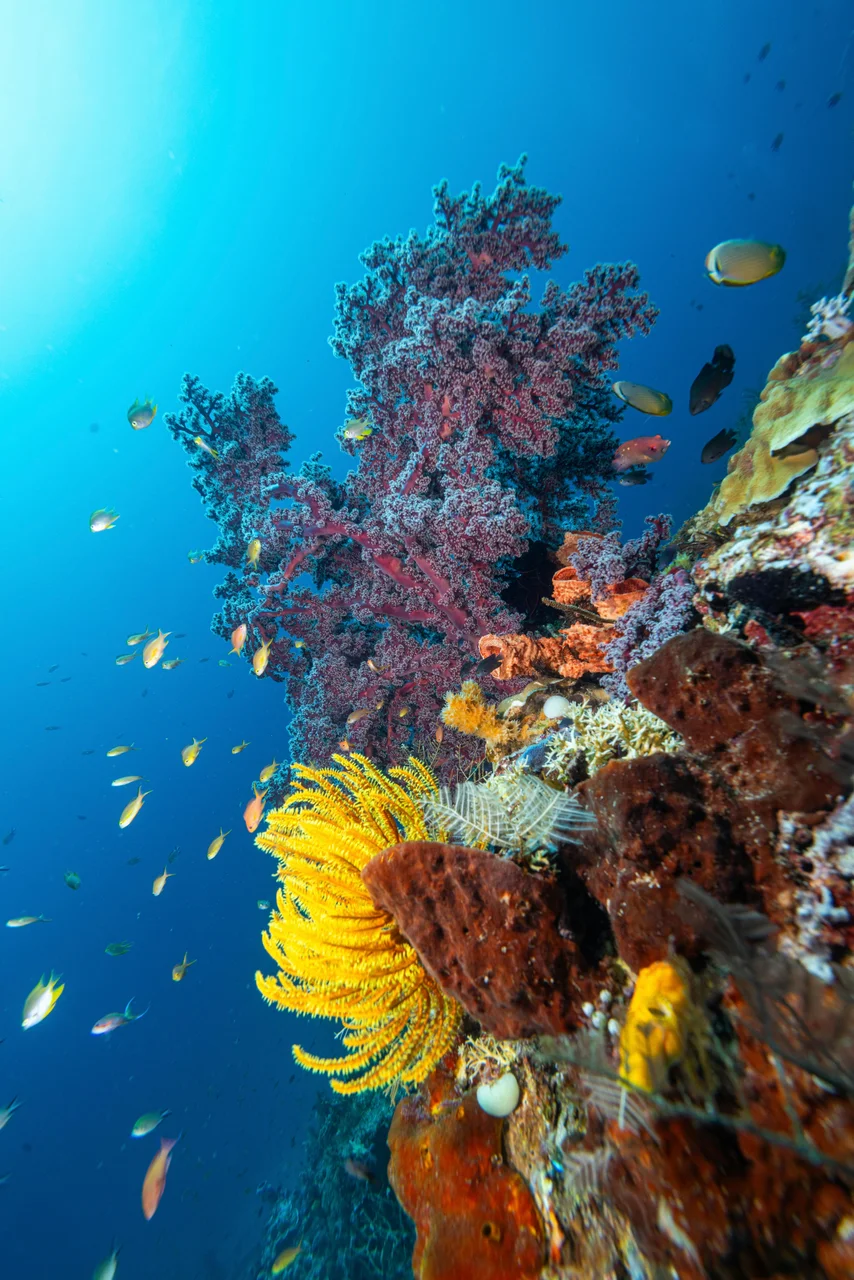
Maratua is the largest and most remote of the four main islands, enclosing a vast lagoon ringed by barrier reef. The outer wall dives here are among the most spectacular in the archipelago—sheer drops festooned with soft coral trees, seafans the size of satellite dishes, and schooling fish in volumes that darken the water. Oceanic triggerfish, humphead wrasse, and patrolling reef sharks are regular features.
Maratua's lagoon is a world unto itself: calm, turquoise, and filled with juvenile fish that shelter in the coral heads lining the sandy lagoon floor. It is an excellent shallow dive or snorkel for days when conditions on the outer reef are less cooperative.
Marine Life at a Glance
The biodiversity of the Derawan Islands is a product of their position in the Coral Triangle and the variety of habitats they encompass:
- Green and Hawksbill Sea Turtles: Resident and nesting populations across all four islands.
- Oceanic and Reef Manta Rays: Most reliably encountered at Sangalaki's cleaning stations.
- Stingless Jellyfish: Unique to Kakaban's landlocked lake.
- Whale Sharks: Occasional visitors, sometimes attracted by fish aggregations near the islands.
- Bumphead Parrotfish: Large schools on the outer reef walls.
- Grey Reef Sharks and Whitetip Reef Sharks: Common at most sites.
- Ghost Pipefish, Frogfish, and Nudibranchs: Exceptional macro life on the house reefs.
- Dugongs: Occasionally sighted in seagrass meadows between islands.
Diver Suitability and Conditions
The Derawan Islands cater to a wider range of experience levels than more current-swept destinations like Alor. Derawan's house reef, the jellyfish lake, and the calmer Maratua lagoon are appropriate for Open Water-certified divers. Sangalaki's manta sites suit Advanced Open Water divers, as currents can be present. The outer walls of Kakaban and Maratua require comfort with drift diving and strong currents.
For the jellyfish lake specifically, note that the experience is more snorkelling than diving—the lake is shallow and the dramatic effect is best enjoyed in the upper water column where jellyfish concentrations are densest.
Practical Tips for Derawan
- Combine the islands: A single-island trip misses the point. Budget at least 5–7 dive days to properly explore Derawan, Sangalaki, Kakaban, and Maratua.
- Go early to Sangalaki: Manta ray activity is most consistent in the morning hours before boat traffic increases.
- Respect the jellyfish lake: Stay off the bottom—the sediment is delicate and disturbing it clouds visibility rapidly. Fins are sometimes prohibited; follow your guide's instructions.
- Protect your camera: The jellyfish lake is a photographer's dream but also a lens-smearing challenge. A dome port and a careful pre-dive rinse will help.
- Arrange permits in advance: Kakaban requires an entrance fee, and some operators handle this as part of a package. Confirm logistics before you travel.
- Carry a dive light: The undercuts and crevices of Kakaban's outer wall hide sleeping nurses sharks and sea turtles—a torch reveals them without disturbing the reef.
Conservation Context
The Derawan Islands sit within an area of intense conservation interest. WWF and local NGOs have worked with fishing communities to reduce turtle poaching and establish marine protected zones. As a visiting diver, you contribute directly to the case for conservation: marine tourism that generates income for local communities is one of the most effective arguments against destructive fishing practices. Choose operators who employ local guides, pay fair wages, and actively support reef monitoring programmes.
Conclusion: Derawan Is Worth Every Kilometre
The Derawan Islands demand effort. The journey is long, the logistics are complex, and the creature comforts are modest. But the archipelago repays every inconvenience with interest. Where else in the world can you spend the morning drifting through a cloud of stingless jellyfish, the afternoon watching manta rays circle overhead at a cleaning station, and the evening logging a turtle encounter on the house reef, all within a single day? Derawan is not a destination you stumble upon—it's one you choose deliberately, knowing that what waits beneath the surface of the Celebes Sea is worth every kilometre of the journey to reach it.
Written by GeckoDive Team
The official GeckoDive team sharing diving knowledge, gear reviews, and destination guides.