31 New Deep-Sea Species Discovered Off Brazil in Just Two Weeks
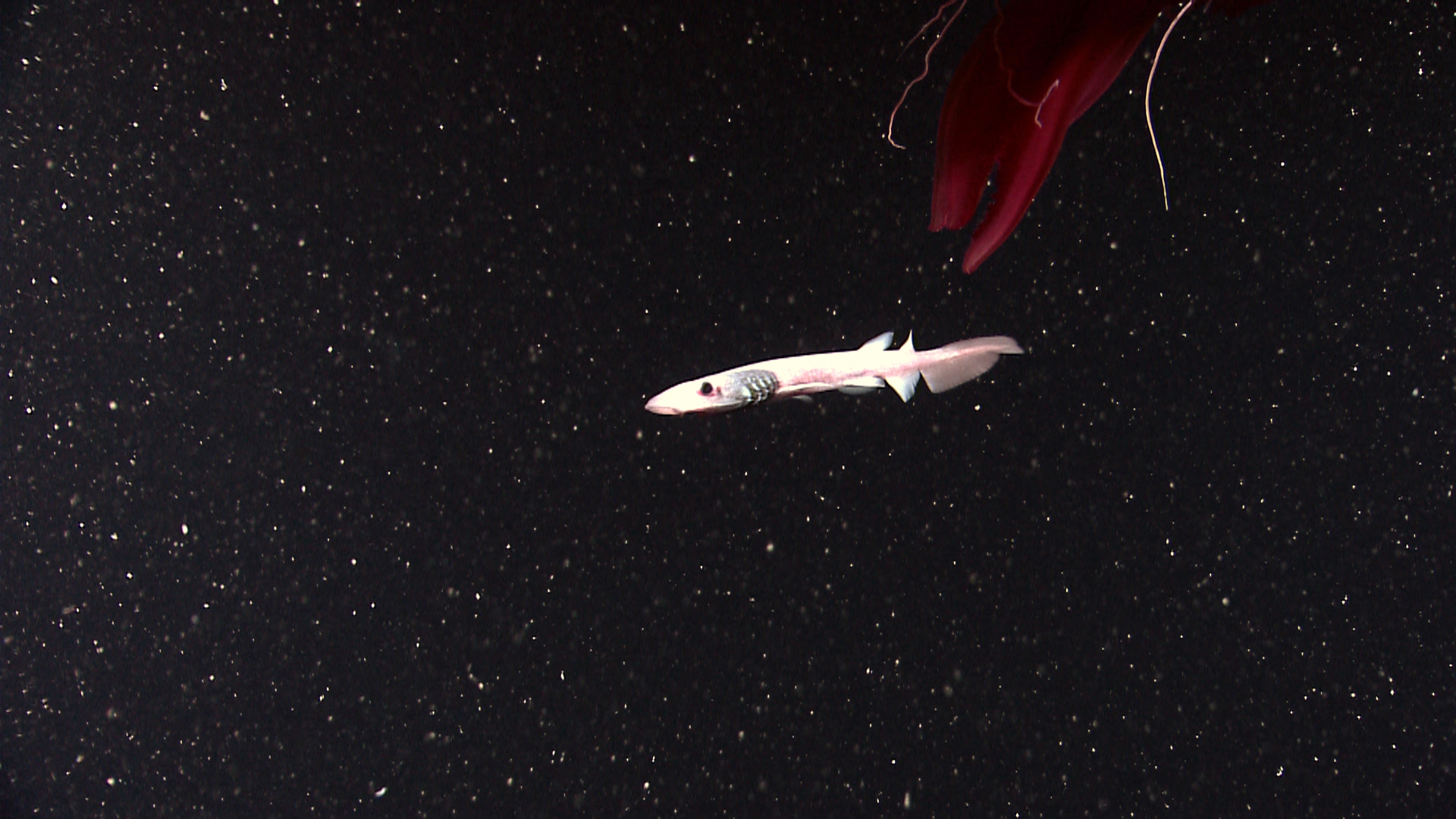
Jellyfish tentacles over a small catshark. NOAA Okeanos Explorer Program, Channel Islands, 2011. Public domain.
An international team of scientists aboard the Falkor (too) research vessel has discovered 31 new marine species in the ocean's mysterious midwater — the largest habitat on Earth — in what may be a record-breaking two-week expedition.
The ocean's midwater — the vast, dark expanse between the sunlit surface and the seafloor — is the largest habitat on Earth. It encompasses 90% of the living space on our planet. And we barely know what lives there.
A recent Schmidt Ocean Institute expedition off the coast of Brazil just gave us a stunning glimpse.
In just two weeks, an international team of two dozen scientists aboard the research vessel Falkor (too) discovered 31 new marine species in the South Atlantic's midwater. The researchers believe the speed at which the species were found and confirmed may be a record — a feat made possible by cutting-edge technology that, for the first time ever, allowed them to observe the living 3D cellular structure of microbial life on board a ship.
What They Found
The list of new species reads like a casting call for a deep-sea fantasy film:
- 9 jellyfish — including a Solmissus (dinner plate jellyfish) observed preying on other midwater creatures
- 7 siphonophores — colonial organisms related to jellyfish and corals, some stretching metres long like living drift nets
- 7 comb jellies (ctenophores) — famous for the glittering, rainbow-like cilia they use to propel themselves through the darkness
- 4 larvaceans — tadpole-like creatures that build intricate mucus "houses" to filter food; remarkably, they're more closely related to humans than to invertebrates
- 1 amphipod — a crustacean relative of crabs and lobsters
- 1 gossamer worm — a creature that moves faster than scientists expect based on its body shape alone
- 2 giant rhizarians — single-celled organisms large enough to see with the naked eye
The team also witnessed extraordinary behaviour: a juvenile glass squid drifting at 779 metres, and a pelagic octopus feeding on a bright red jellyfish — interactions rarely observed, let alone documented.
The Tech That Made It Possible
Normally, identifying and formally describing a new species can take scientists decades. This team confirmed all 31 as new within days.
The breakthrough came from a technology nicknamed the "Squid" — a device that enabled the researchers to observe the living 3D cellular structure of microbial life while still at sea. Combined with advanced ROVs and midwater trawling techniques, the team could identify, image, and genetically sample organisms at a pace previously unimaginable.
"The ocean never let up with surprises in every pocket of water that we explored," said John Burns, Senior Research Scientist at Bigelow Laboratory and one of the expedition's lead scientists.
Karen Osborn, the expedition's chief scientist from the Smithsonian National Museum of Natural History, added: "The largest habitat on Earth, the midwater, is filled with incredible animals we are only just starting to understand. I continue to be fascinated by the fantastic variety of solutions they have evolved to survive in this formidable environment."
Why the Midwater Matters
For divers, the midwater can feel like empty space — the blue you descend through to reach the reef or wreck below. But it's anything but empty. It's the planet's largest animal migration route, where billions of organisms rise toward the surface each night and sink back into the depths by dawn.
Every new species discovered here reshapes our understanding of how life functions in the deep. And with deep-sea mining, climate change, and plastic pollution reaching even the most remote midwater zones, there's urgency to document what's there before it's gone.
A Glimpse of What Remains Unknown
The 31 species from this single expedition are a reminder of just how little we know. If 90% of ocean species are still undiscovered, every descent into the midwater is a journey into the unknown.
As Osborn put it: "That drives me to keep asking questions about our ocean."
Featured image: Jellyfish tentacles drifting over a small catshark, photographed during NOAA's Okeanos Explorer Program in the Channel Islands, 2011. Public domain.
Written by GeckoDive Team
The official GeckoDive team sharing diving knowledge, gear reviews, and destination guides.